Showing posts with label Apple. Show all posts

Thursday, August 24, 2017

Smartwatch: Functionality or Fashion Tech?

Now in 2017, we have a lot of smartwatches, brands and products, that we can choose from in the  market.  2 smartwatches take the top of the list of 'to-be-owned' Apple Watch and Samsung Gear S3.  The rests are Huawei's, Motorola's, TicWatch's and more.  All are designed with fashion in mind and functionalities as tech gadget.
 

Historically, the first smartwatch was born in 1983 by Seiko called Data 2000, becuase it can save up to 2000 characters, with external miniturized keyboard and docking for the watch.
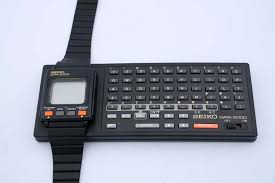

It began a newer function of a watch into a smarter gadget.  The follow ups with bigger data storage, easier entry, and even PC linkage.  Several brand names are synonymous with early smartwatch developments are Casio and Timex.  Until 1994, Timex Datalink was born. The first watch with a more complete functionality, including syncing data with Microsoft Schedule+ and bigger memory space.


From 1998 to 2000, Steve Mann developed the first Linux watch that can be categorized as wearable computer instead of just another watch with data functionality (picture below).  He presented this watch at IEEE ISSCC2000 on 7th February 2000.  The bulky and big watch was not popular, but it did become the father of wearable computing device, or as we know now as simply smartwatch.


Since then, the race for smartwatch began to spin faster.  A decade later, the form and shape of modern smartwatch finally took shape in Pebble, a company who raised their funding from Kickstarter program and gave birth to Pebble Watch in 2012.  The first watch that universally could connect to all smartphones available in the market, waterproof, and battery that last for several days.  No touch screen, only 4 buttons to navigate all notifications and apps within the watch.  The race for the best smartwatch now became a reality that we know today.


Today, when buying a smartwatch, we don't need to think about the form factors since all of them have fashionable designs.  We need to think about what phone we have and whether or not we can utilize the smartwatch to it's optimal capability.  We have a lot of brands to choose from: Apple, Samsung, LG, Huawei, Sony, Casio, Suntoo, Fitbit, and still lot more to count.  Even functionalities has been categorized: daily activities, sport, or health.

So what is the capability of the modern smartwatches that we need to consider before deciding which one is for us:

  1. Master connectivity - we need to consider what smartphone we have and whether or not it can run with the smartwatch.  For example Apple Watch only works with Apple iPhone and Android Wear based smartwatches can only work with Android.  Several brands came out with alternative OS and able to connect to almost every OS a smartphone has such as TicWatch (Android based, not Android Wear), the already bakrupt Pebble can connect to all smartphones including Windows Phone, etc.  
  2. Form factor - with excellent designs come matching your style.  Choose the one that you will wear with pride.
  3. Features - with all the smarter functions, comes features and limitations, such as TicWatch connects better with Android compared to Apple iOS and no Windows Phone connectivity.  There are 2 main category of features to be considered hardware and software.  Some smartwatch can run applications independently from the master phone, such as Apple Watch and Samsung Gear S3.  Here are the list of features to be considered and whether or not these smartwatches have them:
  • Battery life - mostly 1 day, but on a busy notifications day, it might not.  Several smartwatches can last more than 5 days running all the time.  Choose what you need.
  • Bluetooth version - with most smartwatches come with Bluetooth 4.0 and some with 4.2, you need to check whether your phone is capable accepting it.  
  • Connectivity apps - smartwatch works if your smartphone has the matching connectivity app, if your phone cannot run this connectivity app then your smartwatch becomes just another overpriced watch.
  • Accelerometer - this feature enable smartwatches to count your steps, if you are into sport, make sure your selected smartwatch has it.
  • GPS - although not a very common feature, but some high-end smartwatch comes with it's own GPS for tracking your daily run distance and tracks.  If you are training for a marathon or have a strict sport routine, this is a must have.
  • Heart rate sensor - despite being inaccurate in most smartwatches, this feature is important if you have fitness program to do or health problems (such as heart problems, etc).  This sensor can be used to identify your first sign of problem or not to overdue your fitness regime.
  • Memory storage - this is a 2 parts consideration: for apps to run independently to the master smartphone, for storing music and storing temporary data.  The first is clear, so it has a space for apps to be installed in the smartwatch.  The second is related to smartwatch capability to connect to thrid party bluetooth device, such as bluetooth earphones or headphones, to play music without the needs for the smartphone.  And the third, depending on how smart you smartwatch is, enables you to store some data in your smartwatch for temporary purposes, such as voice notes, reminders, etc.
  • Screen visibility - with at least 3 types of screen available, you need to choose the right one for your life style and needs.  E-Ink can be seen easily under direct sun light and very light on battery use making the smartwatch last days without charging.  TFT has the richest color and quite bright, but under direct sun light, it becomes invisible and useless.  AMOLED has the brightest screen but for in door use, it is like a torch shining bright, sometimes too bright.  If you work indoor, you might not need AMOLED screen; if you work outdoor, E-Ink smartwatch is preferable.  Each comes with limitations and advatages, you can choose accordingly.
  • Third party connection - without cable, some smartwatches can connect to third party bluetooth device wirelessly, such as headphones or earphones.  You can play music without your phone.  This helps if you want to store your phone in your locker in a fitness center for safety.
  • Strap replacement - some smartwatches require proprietary straps (Samsung Gear S2, Sony Smartwatch 3, Apple Watch, etc) and some can use regular straps.  This is related to your style and choose the one works best.  Honestly I prefer regular straps so I can pick and choose whatever straps available in the market without depending on a certain brand of straps.
  • Telephony function - there are 2 types of telephony functions in smartwatch, using bluetooth as your handsfree to your phone and sim card injected smartwatch.  An alternate version of Samsung Gear S2 is an example of injected SIM Card smartwatch, enabling users to make calls without the need for smartphones.  Most of smartwatches don't have this features and some high-end watches have the handsfree features (like Dick Tracy watch phone).
  • Add ons - this is new and certainly will become something big later on.  Some smartwatches enable add on to enhance their already complex multifunctionality.  Some third party companies add solar charging straps, handsfree functional straps, removable memory storage, and even E-Ink stylish straps.
Consider all the options you have, it is now easier to choose which smartwatch is suitable for you, in fashion or technological sense.  Or is it making it more complicated?

Saturday, September 10, 2016

Finally, New Technology Breakthrough Are Introduced

It has been a while that I add article to this Blog. Almost 2 years to be exact. The reason being, there not much game changing technologies introduced in the market that actually excites me. The introduction of SmartWatch was big, but it was just a refinement of older technology development. There was no intense excitement in the gadget world, until this September 2016.

Two introduction of new products caught my attention: iPhone 7 family of smartphones and Lenovo Yoga Book. One is a major breakthrough, while the other is actually a minor one instead.

The introduction of iPhone 7 smartphone family without the analog 3.5 mm headphone jack took the world by storm and controversy. Technologists, reviewers, and news media took this development as a storm brewing and changing the world as we know it. In my humble opinion, it's just a minor development. If Apple didn't do it, someone will.

You might wonder why do I think that iPhone 7 without headphone jack is a minor development which is overblown in a gigantic proportion. Well, here are the reasons:

1. June 2016 introduction of Bluetooth 5.0 and its Implementation is coming at the latest early 2017.

Bluetooth wireless technology is the base backbone of current audio wireless technology. Up to version 4.2, Bluetooth is still has major limitation on how much data can be relayed, at max 2.1 Mbps (based on Bluetooth 4.0 specification) or 260 kbps on Bluetooth Low Energy. However,  Bluetooth 5.0 is promised to break the data transfer barrier to 4x the data amount, which means even 24 bit 96 kHz hifi audio quality can be transferred with ease. Do make a note that despite incredible higher speed of data transfer. Bluetooth requires additional data package to be transferred along with audio, hence at max 50% of the max limit will be used for audio data.

But Apple doesn't gamble their name, in fact they will make sure iPhone 7 current or next model is Bluetooth 5.0 compatible. With audio protocol apTX HD being introduced in July 2016, this guarantee iPhone 7 smartphone family is the safe bet of the top of the line smartphone in the market.

2. High End Personal Audio Equipments are now Affordable

Personal Audio industry has bloomed beyond what it was 4 decades ago. The development of portable DAC (Digital to Analog Converter) and micro amplifier have been going towards the micro-size that both will fit into the volume controller module or Earbuds or Earphones body. This technological development ensures those less then adequate audio data sound quality will be improved to significant higher level.

3. Bluetooth Headset Goes Smaller

If you browse through Kickstarter, Indiegogo, eBay or other gadget selling Web marketplace, you will find not 1 or 2, but a big selection of Bluetooth earphones at the size of our outer ear canal from various manufacturers, from cheap small China factories to major brands such as Motorola, Samsung, Sony, etc. These products are maturing right now and more higher quality Bluetooth earphones are being introduced weekly.  AirPods is not a new technology breakthrough, but only Apple's take on those tiny earphones.

In summary, Apple has been known to attract media news makers eyes to them. The introduction of iPhone 7 without headphone jack is not a real major breakthrough. It has been long overdue and it is nothing more but a minor step forward in technology world.

The second product introduction is the working and ready to market Lenovo Yoga Book. It is a Lenovo laptop with 2 10" screen facing each other. Yes, Nintendo has done it first, but only for gaming. Similar technology has also been introduced again and again by other manufacturers and innovators, but nothing like what Lenovo has introduced with Lenovo Yoga Book.

Remember the introduction of the first Samsung Galaxy Note, no one cared. I was so excited by the original Samsung Galaxy Note that I bought a unit at the launching event. The reason was it was the first time someone or some people implemented the use of stylus with the right functionalities. Now, regardless the Note 7 battery disaster, the world still recognizes Samsung Galaxy Note as one of the best smartphone series in the world.

Lenovo Yoga Book is, in my humble opinion, the combination of the right technologies the right way that will change the way we use our tablets, netbooks, or laptops. There are noticeable miscalculations by Lenovo apparent already, similar to Galaxy Note first introduction, but it will still change the way we use and perceived future handheld computers.

Yoga Book was introduce for multipurpose tablet/laptop. You can type using highlighted soft keyboard on the bottom screen which will be activated when we position both screen in laptop configuration (top screen straight up), Yoga Book is now a laptop. You can flip the bottom screen to the back to form a slightly heavier tablet. The upside down V shaped (or make a roof configuration) for watching movies for entertainment purposes.

The last configuration is what determines Yoga Tablet as the major breakthrough in laptop technology, the vertical book configuration. We can use stylus or pen on included pads and papers on the keyboard screen. Whatever we draw or write on the pads will be transferred to Yoga Book as notes, drawings, or editing purposes.  This feature is the key ingredient that will change the way we use tablets and laptops in the future.  Regardless on how advance the technology is, we have not yet abandoned pen and paper. Simply because pen and paper is still the best and most flexible way to take notes and make arts. By combining hardware and software development, Lenovo has produced the most natural way of using laptop/tablet into part of our daily life further.

For those reasons, Lenovo Yoga Book introduction is, in my humble opinion, the major breakthrough that will change the way we use computers in the future.

What do you think, guys? Feel free to comment

Friday, August 30, 2013

Service Center Adventure Report

As you might know, I have been using various brand of mobile phones: Motorola, Apple, Samsung, BlackBerry, HTC and Asus. Part of buying a new phone is also to know what and how is their Service Center works. If your phone has problems, you ight need to face them.

Here are my Reviews on branded phone and their Service Center:

1. Motorola

I have used Motorola Milestone, the GSM version of the original Motorola Droid for international market, for about nearly 2 years. It was my first Android phone.
The phone unit is heavy for its size, being made mostly from metal. The physical keyboard added it's weight. However, I have never have any problem with this unit and never sent it to service center. Brilliant product.
However, Motorola Service Center in Indonesia can be considered rare and hard to find. I don't know whether they are confident of their products or just too expensive to open more.

2. Apple's iPad

Well, it's obviously not a phone and don't make calls. But it is a gadget using SIM card and mobile Internet, so I put it in this list.
Service Centers are spread well. Easy to find also, like in Ratu Plaza, Roxy and Mangga Dua. However, the spare parts are too expensive, the service time is too long coz they need to send it to Singapore.
Unit itself is sturdy as long as you don't drop it. If you do, you're out of luck and need to prepare for the headache of expensive replacement spare parts.

3. Samsung

My first Samsung smartphone is Samsung Galaxy Note N7000, I bought it at its launch after waiting in a long line.
Out of all the service centers, Samsung is probably has the best valued service centers. Easy to find, service is adequate, if not better than competitors, and considerably Fast. Faster than competitors. In max 4 days, you either get your phone fixed or get to know when it will be done. The spare parts, although some are expensive, are reasonably priced. You know you bought a good phone that gets the best after sales when you buy a Samsung smartphone.
Samsung Galaxy Note is famous for having charger USB connector problems. Mine was the power input board got fried. So know it and be prepared.

4. BlackBerry

Fast, but illegal. Confused? BlackBerry, like other American companies, underestimate the huge population number of Indonesia, hence they don't immediately open a Service Center. So tons of non-motorized service centers Pop out everywhere. If you want the authorized service center, your unit will be sent to Singapore.
About 5 years ago, they finally open an office in Jakarta and has several authorized services centers. Nice strategy, fast service means losing your warranty. But for customers, bad after sales services for years and years
All BlackBerry units have problems with the pointing tools, track balls or track pads.

5. HTC

Among all, I must congratulate HTC as the worst service center for international companies, even worse than the local ones.
The staffs are polite but always ask to wait. My phone was held for repaired for 2 months and was asked to wait for another month. Apparently, this happens all over the world. Better avoid HTC if you can.
HTC always have spare parts problems, whether it's the screen or the charger connector or whatever. However, they do creatively build a functional and useful smartphones among all brands.

6. Asus

Asus Padfone 2 can be considered a successful smartphone / tablet. However the unit is easily damaged. You dropped it, just cry and don't bother to repair it. The spare parts are expensive.
The service staffs are very friendly and they always do what they promised. However, Asus internal procedure is slow. It took them 1 week to diagnose the problem, 1 more week to repair it if they have the spare part.

7. Nokia

Is probably the most experienced and the most professional among all smartphone service centers. Their service centers are located in the busiest phone reseller centers and each region has at least 1.
You probably need to wait in a long line cause they have the most units of mobile phones sold, but the service is quick, polite, spare parts always ready, and reasonably priced.

I put Nokia Service Center as the best smartphone service center in Indonesia.

Other brands that I have not been able to review is Sony, Huawei, ZTE, and LG. I have never used any of their devices so it's not fair for me to review them.

So there, those are my reviews of smartphones' brands' service centers. Feel free to leave any comment and share your experience also.

Thursday, July 18, 2013

Basic Knowledge to Digital Music Part 1

The music and it's format:

In this part, we discuss the numerous formats music is available in this digital age. Let's consider that CD/DVD are the source that use PCM audio format (big files, a 4 minute song can be stored at 50MB size file) , so any ripped musics from the source needs to be converted into a certain format of digital music file. Here are some of the most important to know:

- MP3
This is a standard format to get a smaller size of music. Of course, being smaller in size means there are quality to sacrifice. Most common in today's are 64kbps-320 kbIt/s. The higher the better. However, even at the highest conversion, the music quality will still lost parts of the music when compared to the original or higher end format. Regular music file in MP3 format usually is 3MB-12MB depending on the conversion method.  By audiophiles and Headfi-ers, mp3 is considered a lossy format since some of the music are cut off due to the smaller size of the file.

- Apple and Windows format
Both Microsoft and Apple produces wma and m4a as their standard format. Both also has lossless version which has more details, but still loss details. These 2 formats are better than Mp3. However, each has different quality. wma has bigger size file. Mostly sized at 4MB-20MB.
Both Apple and Microsoft also built a lossless format called ALAC and WAVE.

- FLAC
FLAC format is commonly know among the audiophiles and Headfi-ers as the minimum standard of high fidelity music file. The details are more apparent and significantly higher quality compared to the previous formats. The file also significantly larger: +/- 30MB.
FLAC measurement is using unit data measurement between 8-24 bit.

- WAVE
This format is is probably the closest to the source and even has more details compared to the rest. Significantly more high quality means the listeners can listen to all instruments played in a music as presented and intended by the musicians. Close to original means the loss of quality is very little that human ears usually can't recognize the difference immediately. The file size is usually +/-40MB depending on the conversion and music duration. A 2 minute song would be around 20MB in size when converted to WAVE format.
Although there are still arguments, WAVE is considered to be the best digital format available for digital music. However also the lost difficult to play. The measurement standard is also measured in kHz instead of kbps. Most common standard found is 8-24 bit.
To those not familiar with high definition recording, Wave format musics are considered bright, high in treble. This is due to the high details contained in the music file. Hence you will need a higher level headphones or speakers to play the file to reproduce it's high detailed music.

- ALAC
Apple lossless format is also common in iPod and iPhone. Like Wave format, the file is is large, bit not as large as the  original. It is smaller than Wave and has different musical characteristic since it has Apple musical signature of sound. Although it is also high in details, more boomy bass is apparent.
Alac can only be played in Apple standard player: iTunes, iPod, iPad and iPhone. With this limitation, Wave is more popular among Headfi-ers and audiophiles.

There several lore formats available, but it is less common, like ogg, aiff, etc.
If you found a high end mp3 player capable of playing high end music format, don't be surprised that at 64 MB is still considered a small player. High end music player examples: SanDisk Sansa, Cowon, iRiver, HiFiMan, and so on. Although iPod is capable to play lossless formats, most audiophiles considered them lower level quality in  term sound produced.
As an example, even at lossless format, iPod will play drum beats with boomy beats or guitar riffs extended to mask the lost details. While in other high end players, you can heard the drum stick hitting the drum skin or guitar pick striking the string of guitar.
The result is a different experience of listening. Higher details means we listen to music as intended by the musicians. While lossy music is just a music played like in an FM radio (reproduced to equal as 128kbps mp3).

Warning: Once you got used to hear the high end music standard format, you will always feel lossy format lack of "spirit".

Source:
http://en.m.wikipedia.org/wiki/Comparison_of_audio_formats

Saturday, January 5, 2013

A Story of Ralf Rottman in Gizmodo

An iPhone Lover’s Confession: I Switched To the Nexus 4. Completely. http://gizmodo.com/5973073/