
Historically, the first smartwatch was born in 1983 by Seiko called Data 2000, becuase it can save up to 2000 characters, with external miniturized keyboard and docking for the watch.
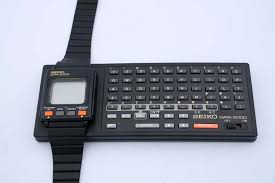
It began a newer function of a watch into a smarter gadget. The follow ups with bigger data storage, easier entry, and even PC linkage. Several brand names are synonymous with early smartwatch developments are Casio and Timex. Until 1994, Timex Datalink was born. The first watch with a more complete functionality, including syncing data with Microsoft Schedule+ and bigger memory space.

From 1998 to 2000, Steve Mann developed the first Linux watch that can be categorized as wearable computer instead of just another watch with data functionality (picture below). He presented this watch at IEEE ISSCC2000 on 7th February 2000. The bulky and big watch was not popular, but it did become the father of wearable computing device, or as we know now as simply smartwatch.

Since then, the race for smartwatch began to spin faster. A decade later, the form and shape of modern smartwatch finally took shape in Pebble, a company who raised their funding from Kickstarter program and gave birth to Pebble Watch in 2012. The first watch that universally could connect to all smartphones available in the market, waterproof, and battery that last for several days. No touch screen, only 4 buttons to navigate all notifications and apps within the watch. The race for the best smartwatch now became a reality that we know today.

Today, when buying a smartwatch, we don't need to think about the form factors since all of them have fashionable designs. We need to think about what phone we have and whether or not we can utilize the smartwatch to it's optimal capability. We have a lot of brands to choose from: Apple, Samsung, LG, Huawei, Sony, Casio, Suntoo, Fitbit, and still lot more to count. Even functionalities has been categorized: daily activities, sport, or health.
So what is the capability of the modern smartwatches that we need to consider before deciding which one is for us:
- Master connectivity - we need to consider what smartphone we have and whether or not it can run with the smartwatch. For example Apple Watch only works with Apple iPhone and Android Wear based smartwatches can only work with Android. Several brands came out with alternative OS and able to connect to almost every OS a smartphone has such as TicWatch (Android based, not Android Wear), the already bakrupt Pebble can connect to all smartphones including Windows Phone, etc.
- Form factor - with excellent designs come matching your style. Choose the one that you will wear with pride.
- Features - with all the smarter functions, comes features and limitations, such as TicWatch connects better with Android compared to Apple iOS and no Windows Phone connectivity. There are 2 main category of features to be considered hardware and software. Some smartwatch can run applications independently from the master phone, such as Apple Watch and Samsung Gear S3. Here are the list of features to be considered and whether or not these smartwatches have them:
- Battery life - mostly 1 day, but on a busy notifications day, it might not. Several smartwatches can last more than 5 days running all the time. Choose what you need.
- Bluetooth version - with most smartwatches come with Bluetooth 4.0 and some with 4.2, you need to check whether your phone is capable accepting it.
- Connectivity apps - smartwatch works if your smartphone has the matching connectivity app, if your phone cannot run this connectivity app then your smartwatch becomes just another overpriced watch.
- Accelerometer - this feature enable smartwatches to count your steps, if you are into sport, make sure your selected smartwatch has it.
- GPS - although not a very common feature, but some high-end smartwatch comes with it's own GPS for tracking your daily run distance and tracks. If you are training for a marathon or have a strict sport routine, this is a must have.
- Heart rate sensor - despite being inaccurate in most smartwatches, this feature is important if you have fitness program to do or health problems (such as heart problems, etc). This sensor can be used to identify your first sign of problem or not to overdue your fitness regime.
- Memory storage - this is a 2 parts consideration: for apps to run independently to the master smartphone, for storing music and storing temporary data. The first is clear, so it has a space for apps to be installed in the smartwatch. The second is related to smartwatch capability to connect to thrid party bluetooth device, such as bluetooth earphones or headphones, to play music without the needs for the smartphone. And the third, depending on how smart you smartwatch is, enables you to store some data in your smartwatch for temporary purposes, such as voice notes, reminders, etc.
- Screen visibility - with at least 3 types of screen available, you need to choose the right one for your life style and needs. E-Ink can be seen easily under direct sun light and very light on battery use making the smartwatch last days without charging. TFT has the richest color and quite bright, but under direct sun light, it becomes invisible and useless. AMOLED has the brightest screen but for in door use, it is like a torch shining bright, sometimes too bright. If you work indoor, you might not need AMOLED screen; if you work outdoor, E-Ink smartwatch is preferable. Each comes with limitations and advatages, you can choose accordingly.
- Third party connection - without cable, some smartwatches can connect to third party bluetooth device wirelessly, such as headphones or earphones. You can play music without your phone. This helps if you want to store your phone in your locker in a fitness center for safety.
- Strap replacement - some smartwatches require proprietary straps (Samsung Gear S2, Sony Smartwatch 3, Apple Watch, etc) and some can use regular straps. This is related to your style and choose the one works best. Honestly I prefer regular straps so I can pick and choose whatever straps available in the market without depending on a certain brand of straps.
- Telephony function - there are 2 types of telephony functions in smartwatch, using bluetooth as your handsfree to your phone and sim card injected smartwatch. An alternate version of Samsung Gear S2 is an example of injected SIM Card smartwatch, enabling users to make calls without the need for smartphones. Most of smartwatches don't have this features and some high-end watches have the handsfree features (like Dick Tracy watch phone).
- Add ons - this is new and certainly will become something big later on. Some smartwatches enable add on to enhance their already complex multifunctionality. Some third party companies add solar charging straps, handsfree functional straps, removable memory storage, and even E-Ink stylish straps.
Consider all the options you have, it is now easier to choose which smartwatch is suitable for you, in fashion or technological sense. Or is it making it more complicated?
